

Please note: This website contains affiliate links. As an Amazon Associate, we earn from qualifying purchases at no additional cost to you.
If you started a GLP-1 medication and suddenly noticed a burning feeling creeping up your chest after dinner — or you’re waking up at 2 a.m. with that awful sour taste in your throat — you’re not imagining it.
Acid reflux and heartburn are two of the most common (and least talked about) side effects of medications like Zepbound, Wegovy, Mounjaro, and Ozempic.
Here’s where I’m coming from on this one: I’ve been on Zepbound for a little over a year now, and long before I ever took my first dose, I was already dealing with pretty severe GERD (gastroesophageal reflux disease) — including Barrett’s esophagus. So reflux management wasn’t new territory for me. I already had systems and daily habits in place, and honestly, that’s the main reason I’ve been able to avoid most of the reflux flare-ups so many people experience on these medications.
Today I’m sharing exactly what those systems look like — 11 practical strategies you can start using today. And stick around for the end, because this story has a genuinely happy plot twist.
Quick note: I’m not a doctor, and this isn’t medical advice — especially if you have GERD, Barrett’s, or any other digestive condition, please work with your own doctor on your plan. This is simply what has worked for me.
Having an Acid Reflux Flare-Up Right Now? Start Here
If you found this article because your chest is on fire at this very moment, do these things first and come back for the prevention plan:
- Get upright and stay upright — stand or sit tall; gravity is your fastest fix
- Loosen your waistband — take the pressure off your stomach immediately
- Sip something soothing — small sips of water or warm ginger tea (skip the milk; it can backfire)
- Chew sugar-free gum for 15–20 minutes — it boosts saliva, which naturally neutralizes acid
- Don’t lie down — if you must rest, prop your upper body up on a firm incline
If heartburn flare-ups like this are happening regularly, the rest of this article is about making them stop.
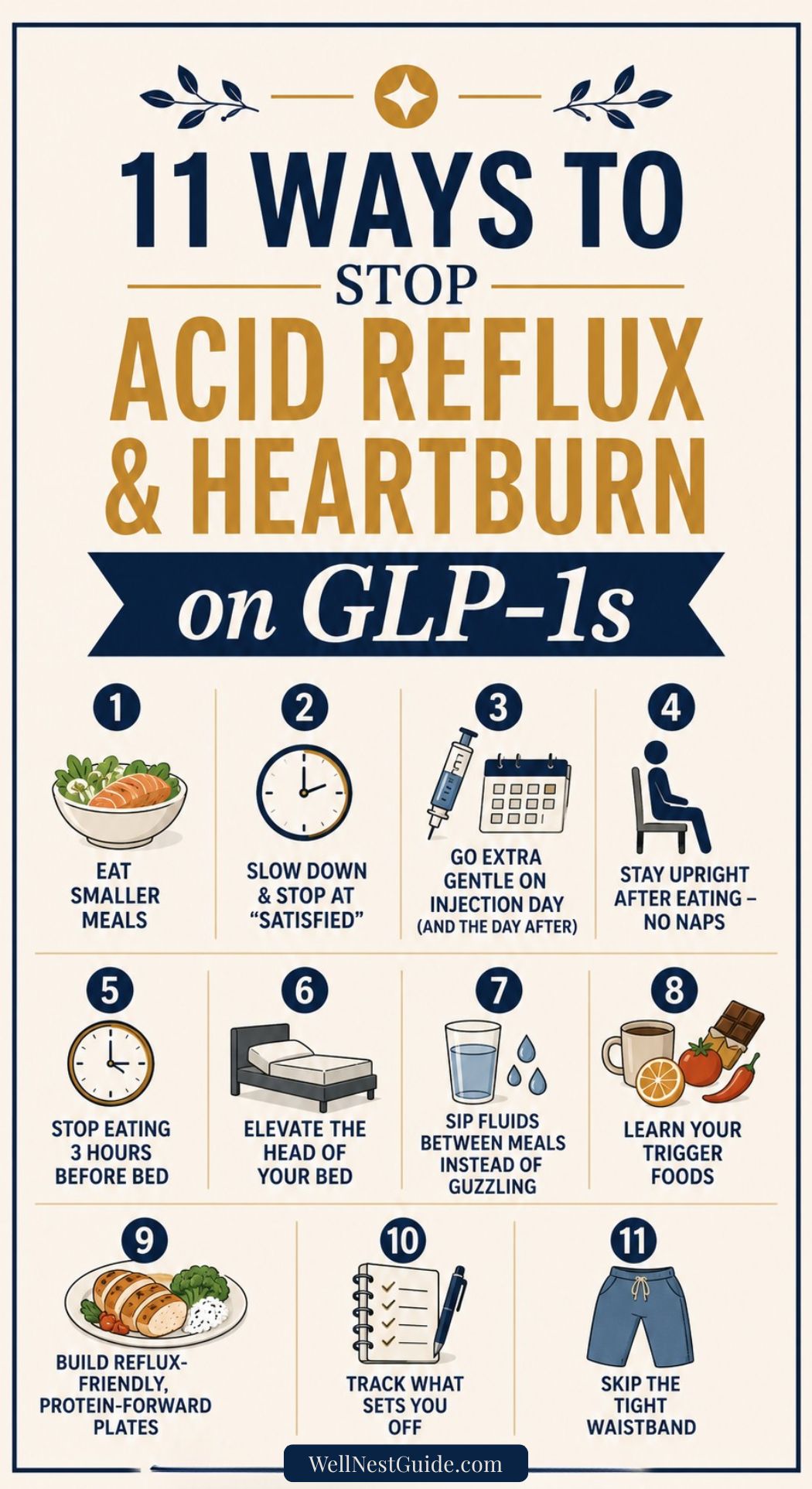
Heartburn + Acid Reflux Relief: 11 Tips at a Glance
Short on time? Here’s the full list — each one is explained in detail below:
Skimming? Here are all 11 tips at a glance:
- Eat smaller meals
- Slow down and stop at “satisfied”
- Go extra gentle on injection day (and the day after)
- Stay upright after eating — no post-meal naps
- Stop eating 3 hours before bed
- Elevate the head of your bed (not just pillows)
- Sip fluids between meals instead of guzzling with them
- Learn your trigger foods
- Build reflux-friendly, protein-forward plates
- Track what sets you off
- Skip the tight waistband
Now let’s dig into each one — including the details that make them actually work.
First, Why GLP-1 Medications Cause Acid Reflux and Heartburn
Quick terminology moment, because these words get used interchangeably: acid reflux is what’s happening (stomach acid traveling back up into your esophagus), and heartburn is what it feels like (that burning sensation in your chest or throat). When reflux happens frequently, doctors call it GERD. Same root problem, three different words — so everything in this article applies whether you’d describe your symptom as heartburn, reflux, or “that awful burning thing.”
GLP-1 medications work partly by slowing down how quickly food leaves your stomach. That’s a feature, not a bug — it’s a big part of why you feel full longer and why the food noise quiets down.
But there’s a trade-off. When food (and stomach acid) sits in your stomach longer, there’s simply more time and more opportunity for acid to travel back up where it doesn’t belong. Add in a big meal, a late dinner, or trigger foods, and you’ve got the perfect recipe for heartburn.
This is also why reflux often shows up or gets worse right after a dose increase. Your stomach is emptying even more slowly than before, and your old eating habits haven’t caught up yet.
The good news? Once you understand the mechanism, the fixes make a lot of sense.
1. Eat Smaller Meals — This Is the Big One
If you only take one thing from this article, make it this. A large meal on a GLP-1 is a double whammy: your stomach is already emptying slowly, and now it’s also overfilled. Something has to give, and usually it’s that valve at the top of your stomach.
I eat smaller portions more often rather than two or three big meals. Conveniently, the medication makes this easier because you’re just not that hungry anyway. Blended soups, small protein plates, and snack-sized meals are your friends here.
2. Slow Down and Stop at “Satisfied,” Not “Full”
Eating quickly means swallowing more air and dumping a lot of food into a stomach that’s working in slow motion. Both add pressure — and pressure is what pushes acid up.
There’s a second layer to this on a GLP-1: your fullness signal can lag behind what’s actually in your stomach. If I eat until I feel full, I’ve usually already overdone it. I aim for satisfied, put my fork down, and give it 20 minutes. Nine times out of ten, satisfied was full — my brain just hadn’t gotten the memo yet.
3. Go Extra Gentle on Injection Day (and the Day After)
Here’s one you won’t find in generic reflux articles: your symptoms probably aren’t the same every day of the week. The medication’s effect on your stomach is strongest in the day or two right after your shot — which means digestion is at its slowest, and acid reflux risk is at its highest.
I plan for it. On injection day and the day after, I lean into my gentlest meals: blended soups, cottage cheese bowls, overnight oats, smoothies. I save the heavier or riskier meals (if I’m having them at all) for the back half of my week, when the effect has eased slightly.
Once I connected my flare-ups to my shot schedule, a lot of the “why is this happening today?” mystery disappeared.
4. Stay Upright After Eating (Yes, Even for Naps!)
Gravity is doing half the work of keeping acid where it belongs, and lying down takes it off the job. That post-dinner couch collapse — especially tempting if you’re dealing with GLP-1 fatigue — is one of the fastest routes to a flare-up.
I stay upright for at least 30 to 60 minutes after eating. If I’m wiped out, I’ll relax propped up rather than flat. Small change, big payoff.
5. Follow the 3-Hour Rule Before Bed
This is the habit that eliminated most of my nighttime symptoms years before Zepbound: I stop eating at least three hours before I lie down for the night.
It matters even more on a GLP-1, because your stomach may still be partly full hours after you eat. A 9 p.m. snack before a 10 p.m. bedtime is basically asking to wake up at 2 a.m. with a burning throat.
PRO TIP: When I’m having severe acid reflux, I try to stop eating at least 5 hours before bed. It’s really helped me over the years!
6. Elevate the Head of Your Bed
For nighttime reflux, this one is a game changer. I sleep with my upper body slightly elevated — a wedge pillow works, or you can raise the head of the bed frame a few inches.
One important note: stacking regular pillows doesn’t really work. You just bend at the waist, which compresses your stomach and can actually make reflux worse. You want a gentle incline from the hips up.
I bought this bed wedge pillow and while it took a few night to get used to it, it really helped!

Bed Wedge Pillow for Acid Reflux Relief
Check Pricing on Amazon
$39.99
We earn a commission if you make a purchase, at no additional cost to you.
09/25/2026 10:09 am GMT
7. Sip, Don’t Guzzle
Hydration matters on GLP-1s — it helps with constipation, fatigue, and dizziness — but chugging a big glass of water with your meal fills up a stomach that’s already slow to empty.
I sip fluids steadily between meals and keep drinks small during meals. Your stomach gets to focus on the food instead of managing a flood.
8. Know Your Trigger Foods
Everyone’s triggers are a little different, but these are the classic offenders — and they hit harder on a GLP-1 because they sit in your stomach longer:
- Fried and fatty foods — fat slows digestion even further on top of the medication
- Spicy foods — a trigger for many, though not everyone
- Tomato sauce and citrus — acidic foods that can irritate on the way down and the way up
- Coffee — painful to hear, I know; try smaller amounts, earlier in the day, not on an empty stomach
- Carbonated drinks — bubbles expand in a slow-emptying stomach and push acid upward (this also overlaps with sulfur burps, if you’re dealing with those too)
- Chocolate and peppermint — both can relax the valve that’s supposed to keep acid in your stomach
- Alcohol — relaxes that same valve and irritates the esophagus
You don’t necessarily have to eliminate all of these forever. Cut the obvious ones during a flare-up, then reintroduce one at a time to find your triggers.
9. Build Reflux-Friendly Plates That Still Hit Your Protein Goals
Here’s the tricky part on a GLP-1: you’re trying to prioritize protein with a small appetite, and now you have to be reflux-aware too. These are my go-to foods that check both boxes:
- Lean proteins, gently cooked — baked or grilled chicken, turkey, white fish. Skip the deep fryer and heavy cream sauces.
- Cottage cheese and Greek yogurt — low-acid dairy, protein powerhouses, and easy on a small appetite
- Eggs and egg whites — for some people yolks can be a mild trigger; egg whites almost never are
- Oatmeal and overnight oats — genuinely soothing, high in fiber, and easy to boost with protein powder or chia
- Blended soups — warm, gentle, easy to eat when your appetite is low, and simple to pack with protein
- Bananas and melon — the low-acid fruits
- Non-citrus smoothies — banana, berries in moderation, oats, protein powder, almond milk
- Ginger — the classic stomach-soother; ginger tea after meals is one of my favorites
Small, protein-forward, lower-fat plates are the sweet spot: gentle on reflux and perfectly suited to a GLP-1 appetite.
10. Track What Sets You Off
Reflux is wildly individual. The food that wrecks one person’s evening is completely fine for someone else — and your triggers can even shift as your dose changes.
Keep a simple log for a week or two: what you ate and drank, how fast you ate, the time of day, and whether you laid down afterward. Nothing fancy — a note on your phone works. Patterns show up surprisingly fast, and it saves you from the endless trial-and-error guessing game.
11. Skip the Tight Waistband
Tight clothing around your middle puts physical pressure on your stomach and pushes acid upward. As you lose weight this becomes less of an issue anyway, but on injection days or heavier-meal days, comfortable clothes make a real difference. Consider it medical permission to wear the stretchy pants.
The Plot Twist: Losing Weight Actually Improved My GERD
Here’s the part I really want you to hear, especially if you have long-standing reflux and you’re nervous about starting a GLP-1.
Extra weight — particularly around the midsection — puts constant pressure on your stomach, which pushes acid up into the esophagus. It’s one of the biggest risk factors for GERD in the first place.
So while the medication itself can aggravate reflux in the short term, the weight loss it produces works in the opposite direction over time.
As I lost weight on Zepbound, my GERD actually improved. Fewer flare-ups, fewer symptoms, less reliance on rescue remedies and a dramatic reduction in my prescription medication — despite being on a medication that’s “supposed to” make reflux worse.
If you’re in the rough early weeks, that’s worth holding onto: manage the short-term symptoms with the habits above, and the long-term trend may genuinely move in your favor.
When to Talk to Your Doctor
Please don’t white-knuckle through severe or persistent reflux. Talk to your doctor if:
- Symptoms are frequent (more than a couple of times a week) or getting worse
- You’re waking up at night with reflux regularly
- You have trouble swallowing, or food feels like it’s getting stuck
- You’re losing weight faster than expected along with severe GI symptoms
- Over-the-counter remedies aren’t cutting it
Your doctor may adjust your dose, slow your titration schedule, or discuss acid-reducing medication. And if you have chronic GERD like me — and especially if you’ve ever been told you have Barrett’s esophagus — regular follow-up matters. That’s a condition you monitor with your GI doctor, not manage with home remedies alone.
GLP-1 Acid Reflux: FAQs
Does Zepbound cause heartburn?
It can. Acid reflux, heartburn, and GERD symptoms are recognized side effects of tirzepatide and other GLP-1 medications, largely because of delayed stomach emptying. Not everyone experiences it, and for many people it improves as their body adjusts.
Will the acid reflux go away?
Often, yes — especially if it appeared after starting or increasing your dose. Symptoms frequently settle as your body adapts and as your eating habits adjust to the slower digestion. And as weight comes off, many people (myself included) see their baseline reflux improve.
Can I take antacids or acid reducers with my GLP-1?
Many people do use antacids or acid-reducing medications alongside GLP-1s, but check with your doctor or pharmacist first about what’s appropriate for you, how often, and about timing relative to your other medications.
Should I stop my medication because of reflux?
Don’t stop on your own — talk to your prescriber. There’s usually a middle path: dose adjustments, slower titration, habit changes, or short-term acid support.
Please note: This website contains affiliate links. As an Amazon Associate, we earn from qualifying purchases at no additional cost to you.