

Please note: This website contains affiliate links. As an Amazon Associate, we earn from qualifying purchases at no additional cost to you.
You’re mid-sentence, mid-meal, or mid-meeting — and suddenly your body decides it’s time for hiccups.
They’re harmless, they’re annoying, and somehow every person you know has a different “guaranteed” cure.
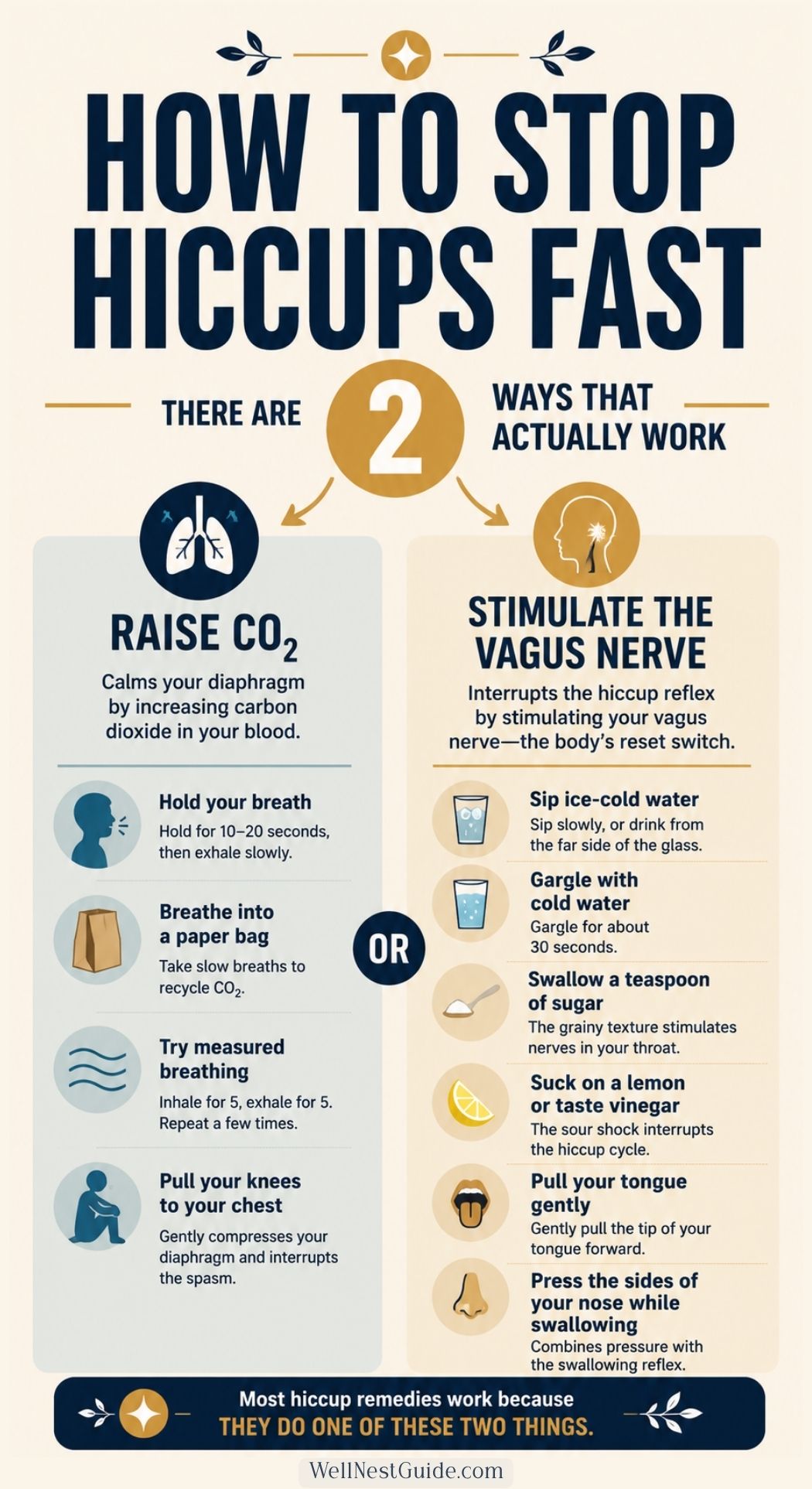
Here’s the good news: some of those folk remedies actually have science behind them. Most hiccup cures work by doing one of two things — interrupting the nerve signals that cause hiccups, or raising the carbon dioxide level in your blood. Once you know that, you can skip the myths and go straight to the methods that work.
Let’s get you back to normal breathing.
What Causes Hiccups in the First Place?
A hiccup is an involuntary spasm of your diaphragm — the dome-shaped muscle under your lungs that controls breathing. When the diaphragm contracts suddenly, your vocal cords snap shut, producing the classic “hic” sound.
The spasm itself is usually triggered by irritation of the vagus or phrenic nerves, which run from your brain down through your neck and chest to your diaphragm. Common everyday triggers include:
- Eating too quickly or eating too much
- Carbonated drinks
- Swallowing air (talking while eating, chewing gum)
- Sudden temperature changes — like a cold drink with a hot meal
- Alcohol
- Stress, excitement, or nervousness
Most hiccups resolve on their own within a few minutes. But if you’d rather not wait, here’s what actually helps.
Breathing Techniques: The CO2 Method
These work by increasing carbon dioxide in your bloodstream, which signals your diaphragm to calm down and return to its normal rhythm.
1. Hold your breath. The classic — and it’s a classic for a reason. Take a deep breath and hold it for 10–20 seconds, then exhale slowly. Repeat a few times if needed.
2. Breathe into a paper bag. Loosely cup a paper bag over your mouth and nose and take slow breaths. This recycles CO2 back into your lungs. (Never use a plastic bag, and stop if you feel lightheaded.)
3. Try measured breathing. Inhale slowly for a count of five, then exhale for a count of five. The slow, controlled rhythm can reset the diaphragm’s spasm cycle.
4. Pull your knees to your chest. Sit down, hug your knees in, and lean forward gently for a minute or two. This compresses the diaphragm and can interrupt the spasm.
Drinking and Swallowing Tricks
These stimulate the vagus nerve — essentially giving your nervous system something else to pay attention to.
5. Sip ice-cold water slowly. The cold plus the repetitive swallowing action stimulates the vagus nerve. Some people swear by drinking from the far side of the glass (leaning forward over the cup) — the awkward position may help by engaging different muscles.
6. Gargle with cold water. Thirty seconds of gargling stimulates the back of the throat, where the vagus nerve is easy to reach.
7. Swallow a teaspoon of sugar. An old remedy with a real mechanism: the grainy texture is thought to mildly stimulate the vagus nerve through the back of the throat. Honey or a bit of peanut butter can work the same way.
8. Suck on a lemon wedge or taste a drop of vinegar. The sour shock does the same job — a strong sensory jolt that interrupts the nerve signals feeding the hiccup loop.
Pressure Point Techniques
9. Press gently on your diaphragm. Use your hand to apply light pressure to the area just below your breastbone.
10. Pull gently on your tongue. Odd but legitimate — grasping the tip of your tongue and gently pulling it forward once or twice stimulates the nerves and muscles in your throat.
11. Press your palm. Press the thumb of one hand firmly into the palm of the other. This is more of a distraction technique, but distraction itself can genuinely help — hiccups sometimes fade the moment your brain focuses elsewhere.
12. Gently press on the sides of your nose while swallowing. Another vagus nerve trick that combines pressure with the swallowing reflex.
How to Get Rid of Hiccups Without Water
Stuck in the car, in a meeting, or nowhere near a sink?
Your best water-free options are the breathing techniques: hold your breath, do slow counted breathing, or pull your knees to your chest. The tongue-pull and palm-press methods also require nothing but your own two hands.
What About Baby Hiccups?
Hiccups are extremely common in babies — they even hiccup in the womb. For infants, don’t use any of the adult remedies above. Instead:
- Pause the feeding and burp your baby
- Offer a pacifier, which can relax the diaphragm
- Let the hiccups run their course — they typically don’t bother babies the way they bother us
If your baby’s hiccups seem frequent, distressing, or interfere with feeding or sleep, mention it to your pediatrician.
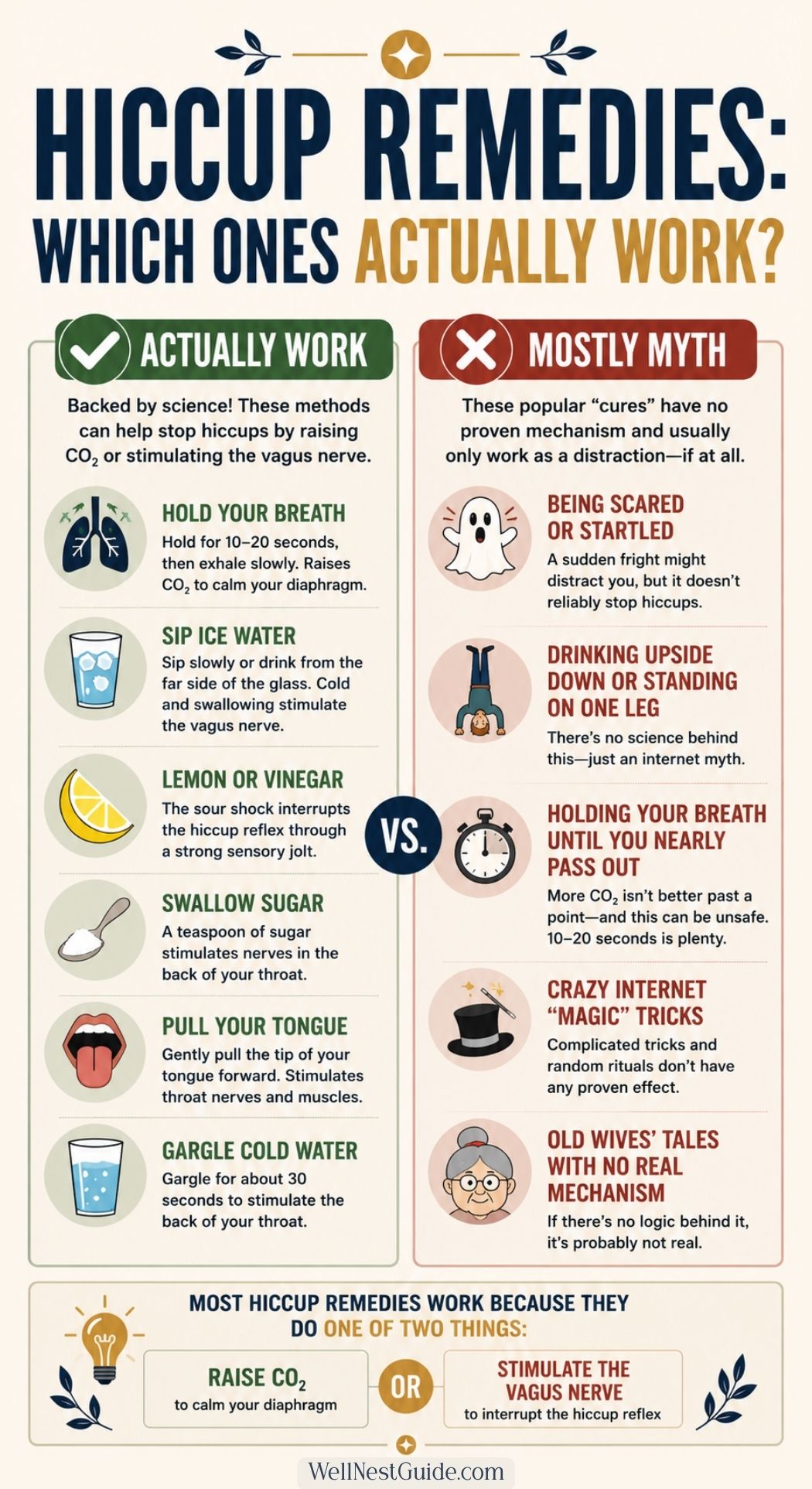
Hiccup “Cures” That Don’t Really Work
- Being scared or startled. The famous one. A sudden fright might interrupt hiccups through distraction, but there’s no reliable mechanism — and it mostly just annoys the person hiccuping.
- Holding your breath until you nearly pass out. More CO2 isn’t better past a point. Ten to twenty seconds is plenty; don’t push it.
- Drinking water upside down while standing on one leg while someone recites the alphabet backward. If it works, it’s the distraction — not the choreography.
How to Prevent Hiccups
If you get hiccups often, a few habits can reduce the frequency:
- Eat smaller meals, more slowly
- Cut back on carbonated drinks and alcohol
- Avoid gulping very hot and very cold things back to back
- Manage stress — anxiety and excitement are genuine triggers
When to See a Doctor About Hiccups
Occasional hiccups are completely normal. But see a healthcare provider if:
- Hiccups last longer than 48 hours (this is called persistent hiccups)
- They interfere with eating, sleeping, or breathing
- They come with pain, reflux, or difficulty swallowing
- They keep recurring frequently for no obvious reason
Long-lasting hiccups can occasionally signal an underlying issue with the nerves, digestive system, or medications you’re taking — and there are prescription treatments for stubborn cases, so you don’t have to just live with them.
FAQs About Stopping Hiccups
What gets rid of hiccups the fastest?
The fastest reliable method combines two approaches: hold your breath for 10–20 seconds (raises CO2), then slowly sip ice-cold water (stimulates the vagus nerve). Together, these address both mechanisms behind hiccups and stop most episodes within a minute or two.
Why do I keep getting hiccups?
Frequent hiccups are usually tied to eating habits — eating too fast, large meals, carbonated drinks, or alcohol. Sudden temperature changes and stress are also common triggers. If hiccups recur often with no obvious cause, or an episode lasts more than 48 hours, check with your doctor.
Does holding your breath really stop hiccups?
Yes — it’s one of the few folk remedies with a real mechanism. Holding your breath raises the carbon dioxide level in your blood, which signals your diaphragm to relax and return to its normal rhythm. Hold for 10–20 seconds and repeat a few times; don’t push past the point of discomfort.
Can GLP-1 medications like Ozempic or Zepbound cause hiccups?
Hiccups aren’t listed as an official side effect in the clinical trials for GLP-1 medications, but some people taking them do report hiccup episodes — and there’s a plausible reason why. These medications slow gastric emptying, which can cause temporary stomach distension that irritates the vagus and phrenic nerves — the same nerves that trigger the hiccup reflex. Hiccups may be more noticeable during dose increases or after larger meals. The standard remedies in this article still work; eating smaller meals more slowly helps prevent them. If hiccups become persistent or bothersome, mention it to your prescriber.
How long is too long for hiccups?
Anything beyond 48 hours is considered persistent hiccups and warrants a call to your doctor. Hiccups lasting over a month (yes, it happens) are called intractable hiccups and can signal an underlying nerve, digestive, or medication issue — and there are prescription treatments available.
Why do babies get hiccups so often?
Babies’ diaphragms and the nerves controlling them are still maturing, and feeding introduces lots of triggers — swallowed air, a full stomach, temperature changes. Baby hiccups are normal and usually don’t bother the baby. Burping mid-feed and offering a pacifier can help them pass.
The Bottom Line
Most hiccups are a minor glitch in your diaphragm’s rhythm, and most of the remedies that work do so by either raising CO2 (breathing tricks) or stimulating the vagus nerve (cold water, sugar, sour flavors, gentle pressure).
Pick one from each category, and you’ve got a reliable two-step plan for the next time hiccups strike.
This article is for informational purposes only and isn’t a substitute for medical advice. If your hiccups persist beyond 48 hours or come with other symptoms, check in with your healthcare provider.
Please note: This website contains affiliate links. As an Amazon Associate, we earn from qualifying purchases at no additional cost to you.