
Please note: This website contains affiliate links. As an Amazon Associate, we earn from qualifying purchases at no additional cost to you.
Have you ever looked in the mirror and thought, “What is going on with me lately?”
Maybe you’re exhausted all the time, even though you’re technically getting enough sleep. Maybe your patience has gotten noticeably shorter. Maybe you’re forgetting simple things, waking up at odd hours, or wondering why your favorite jeans suddenly seem determined to make your life difficult.
The frustrating part is that none of these symptoms seem connected.
You might blame stress. Or getting older. Or the fact that life feels busier than ever. And while all of those things can certainly play a role, sometimes there’s another piece of the puzzle that doesn’t get talked about nearly enough: estrogen.
Most women know estrogen has something to do with periods and menopause, but many don’t realize this hormone influences everything from energy levels and mood to sleep, memory, skin health, and even where your body stores fat.
That’s why low estrogen symptoms can feel so confusing. Instead of one obvious sign, you may start noticing a collection of seemingly random changes that gradually make you feel less like yourself.
If you’ve been wondering whether hormones could be playing a role, here’s what to watch for.
What Does Low Estrogen Actually Feel Like?
One of the reasons low estrogen can be so difficult to identify is because it doesn’t show up the same way for everyone.
For some women, the first clue is trouble sleeping. For others, it’s mood changes, brain fog, or feeling unusually emotional. Some women notice physical changes first, like dry skin, joint aches, or weight gain around the midsection.
Part of the confusion comes from the fact that estrogen does far more than regulate your menstrual cycle.
Estrogen helps support brain function, mood, sleep, bone health, heart health, skin elasticity, muscle maintenance, and reproductive health. When levels begin to fluctuate or decline, multiple systems throughout the body can be affected at the same time.
That’s why low estrogen symptoms often don’t feel like a hormone issue at all. Instead, it can feel like a collection of small frustrations that gradually start adding up.
Let’s start with one of the most common places women notice changes first: their energy and their brain.
Energy and Brain | Low Estrogen Symptoms
1. You’re Exhausted Even After Sleeping
One of the most frustrating things about hormone changes is that they don’t always play by the rules. We’re all told to watch out for hot flashes and night sweats, but nobody really warns you about what can happen to your energy.
You might get a full night’s sleep and still wake up feeling like someone forgot to recharge your battery overnight. By mid-afternoon, that energy crash hits so hard you’re not reaching for a second cup of coffee because it sounds enjoyable—you’re reaching for it because functioning like a normal human suddenly feels negotiable.
Of course, being tired doesn’t automatically mean your estrogen is low. Modern life is exhausting. Most of us are juggling work, family, responsibilities, and an endless to-do list.
But when that deep, persistent fatigue starts hanging around no matter what you do, hormones may deserve a closer look.
2. Brain Fog Has Moved In
You walk into the kitchen and immediately forget why you’re there.
You open the refrigerator, stare for a few seconds, and then close it without accomplishing anything.
You lose your train of thought halfway through a sentence. You can’t remember names as quickly as you used to. Sometimes finding the right word feels oddly difficult, even though it’s sitting somewhere in your brain.
Brain fog is one of those symptoms that can make women question themselves because it’s hard to describe unless you’ve experienced it. You’re still you. You’re still capable. Your brain just feels a little slower and a little fuzzier than it used to.
Estrogen helps support several neurotransmitters involved in memory and cognitive function, which is one reason many women notice changes in concentration and mental sharpness when hormone levels begin to shift.
3. You Feel More Forgetful Than Usual
This symptom often shows up alongside brain fog, but many women describe it slightly differently.
It’s not necessarily forgetting major things. It’s forgetting where you put your phone. Walking into a room and losing your train of thought. Missing appointments you normally wouldn’t forget. Re-reading the same paragraph three times because your mind keeps wandering.
If you’ve been feeling unusually scattered lately, you’re certainly not imagining it.
Many women notice that memory and focus become more challenging during perimenopause and menopause, especially when poor sleep is also part of the picture.
Mood & Emotional Symptoms
4. Your Patience Has Gone Missing
One of the more surprising symptoms of changing hormones is how quickly your emotional thermostat can shift.
Things that normally wouldn’t bother you suddenly feel incredibly irritating. The dog barking. Someone chewing too loudly. The email that could have been a text. The text that could have been no text at all.
You know you’re overreacting, but somehow that realization doesn’t make it any less annoying in the moment.
Estrogen helps influence several brain chemicals involved in mood regulation. When levels begin fluctuating or declining, many women notice they feel less emotionally resilient than they used to. Little stressors can feel bigger, and your patience may feel shorter than normal.
5. Anxiety Shows Up Out of Nowhere
This one catches a lot of women by surprise.
You may have never considered yourself an anxious person, yet suddenly you find yourself worrying more than usual. Your mind races at night. Small problems feel bigger than they should. You feel on edge, even when nothing particularly stressful is happening.
Of course, life itself can create plenty of anxiety. But when those anxious feelings seem to arrive alongside other symptoms like poor sleep, fatigue, or brain fog, hormones may be part of the picture.
Many women describe this phase as feeling like their usual coping skills simply don’t work the way they used to.
6. You’re More Emotional Than Usual
One minute you’re fine.
The next minute you’re tearing up during a dog food commercial, a random social media video, or a heartwarming story that wouldn’t have affected you six months ago.
While mood swings are often associated with PMS, they can also occur when estrogen levels begin changing during perimenopause and menopause.
That doesn’t mean every emotional day is caused by hormones. But if you’ve noticed you’re crying more easily, feeling more sensitive, or experiencing bigger emotional highs and lows than usual, it may be worth considering whether your hormones are contributing.
Sleep Symptoms | Signs of Low Estrogen
7. You’re Awake at 3 A.M. Again
You fall asleep just fine.
Then suddenly you’re wide awake at 3:12 a.m., staring at the ceiling while your brain decides this is the perfect time to replay every awkward conversation you’ve had over the last twenty years.
If this sounds familiar, you’re in good company.
Sleep disturbances are one of the most common symptoms women report during perimenopause and menopause. Some women struggle to fall asleep, while others wake up repeatedly throughout the night and have trouble falling back asleep.
Unfortunately, poor sleep tends to make every other symptom worse. Brain fog feels foggier. Anxiety feels bigger. Fatigue becomes more noticeable.
It’s a cycle many women know all too well.
8. Night Sweats Are Ruining Your Sleep
One minute you’re perfectly comfortable.
The next minute you’re kicking off blankets, flipping your pillow over, and wondering why you’re sweating when everyone else in the house seems perfectly fine.
Night sweats are often one of the earliest signs that hormones may be changing. While they’re commonly associated with menopause, many women experience them during perimenopause as well.
Sometimes they’re mild. Other times they can be disruptive enough to leave you exhausted the next day.
9. Hot Flashes Seem to Come Out of Nowhere
Hot flashes tend to get all the publicity when people talk about low estrogen, but they can be surprisingly difficult to describe until you’ve experienced one.
Many women describe them as a sudden wave of heat that starts in the chest, neck, or face and seems to take over the entire body. They can last a few seconds or several minutes and may leave you sweating, flushed, and uncomfortable.
Not every woman experiences hot flashes, but they’re one of the most recognizable signs that estrogen levels may be changing.
Physical Symptoms
10. Your Skin Feels Drier Than It Used To
If your skincare routine suddenly seems less effective than it used to be, hormones may deserve some credit—or blame.
Estrogen helps support skin hydration, elasticity, and collagen production. As levels decline, many women notice their skin feels drier, thinner, or less plump than it once did.
You may find yourself reaching for extra moisturizer or wondering why your skin suddenly looks different despite using the same products you’ve always used.
11. Your Joints Are Suddenly Complaining
Many women are surprised to learn that estrogen plays a role in joint health.
You might notice stiffness when getting out of bed, achy knees after sitting for a while, or random joint discomfort that seems to appear without explanation.
It’s easy to assume it’s simply aging, but hormonal changes can sometimes contribute to these aches and pains as well.
12. Your Hair Isn’t Acting Like It Used To
Maybe you’re noticing more hair in the shower drain.
Maybe your ponytail feels thinner.
Or perhaps you’ve started paying a little more attention to your hairline than you ever have before.
Hair thinning can happen for many reasons, but changing hormone levels are often part of the conversation during perimenopause and menopause.
13. Your Body Seems To Be Playing By New Rules
This is one of the biggest frustrations women talk about.
You’re eating the same breakfast you’ve always eaten. You’re still trying to stay active. You haven’t dramatically changed your habits.
Yet somehow your favorite jeans seem noticeably less cooperative.
Many women find that even if the scale doesn’t move much, their weight distribution changes. Fat that once settled elsewhere may start showing up around the midsection instead.
It’s often one of the first changes that prompts women to start wondering whether hormones could be involved.
Reproductive Symptoms
14. Your Libido Has Left The Group Chat
Let’s talk about the symptom nobody really enjoys discussing.
If your interest in sex has gone from “sounds good” to “I’d honestly rather take a nap,” you’re not imagining things.
Estrogen helps support vaginal health, comfort, and sexual desire. As levels decline, many women notice that intimacy simply isn’t on their radar as often as it used to be.
Add in poor sleep, stress, work, family responsibilities, and the fact that you’re already exhausted, and it’s easy to see why this symptom shows up for so many women.
15. Your Period Has Become Unpredictable
For women who are still menstruating, changes in your cycle are often among the earliest clues that hormones may be shifting.
Your periods may arrive earlier than usual, later than usual, heavier than usual, or occasionally disappear altogether.
One month everything seems normal. The next month your cycle appears to have completely ignored the calendar.
While irregular periods can happen for many reasons, they are one of the hallmark signs of perimenopause and fluctuating estrogen levels.
When Do Low Estrogen Symptoms Usually Start?
For many women, symptoms begin during perimenopause, which is the transition leading up to menopause.
This stage often starts sometime in your 40s, although some women notice symptoms in their late 30s while others don’t experience significant changes until their 50s.
One thing that makes perimenopause particularly confusing is that estrogen doesn’t decline in a straight line. Some days levels may be relatively normal. Other days they may fluctuate dramatically.
That’s why symptoms can feel unpredictable. One month you feel perfectly fine. The next month you’re wondering why you’re suddenly exhausted, anxious, and waking up at 3 a.m.
What Can You Do If You Think Your Estrogen Is Low?
If several of these symptoms sound familiar, it’s worth having a conversation with your healthcare provider.
At the same time, many women find that supporting their overall health helps them feel better during this transition. Simple habits can make a meaningful difference, including:
- Prioritizing protein at meals
- Eating more fiber-rich foods
- Staying physically active
- Managing stress
- Improving sleep habits
- Including nutrient-dense foods that support overall hormone health
Foods That May Support Hormone Health
While no food can replace estrogen, certain foods contain naturally occurring compounds called phytoestrogens. These plant compounds have been studied for their potential role in supporting hormone health.
Some popular examples include:
- Flaxseed
- Soy foods
- Tofu
- Tempeh
- Edamame
- Chickpeas
- Lentils
- Sesame seeds
If you’re interested in learning more, check out:
- Foods That Support a Healthy Estrogen Balance Naturally
- 12 Easy Hormone Balancing Recipes Made with Estrogen Rich Foods
Frequently Asked Questions
What are the most common low estrogen symptoms?
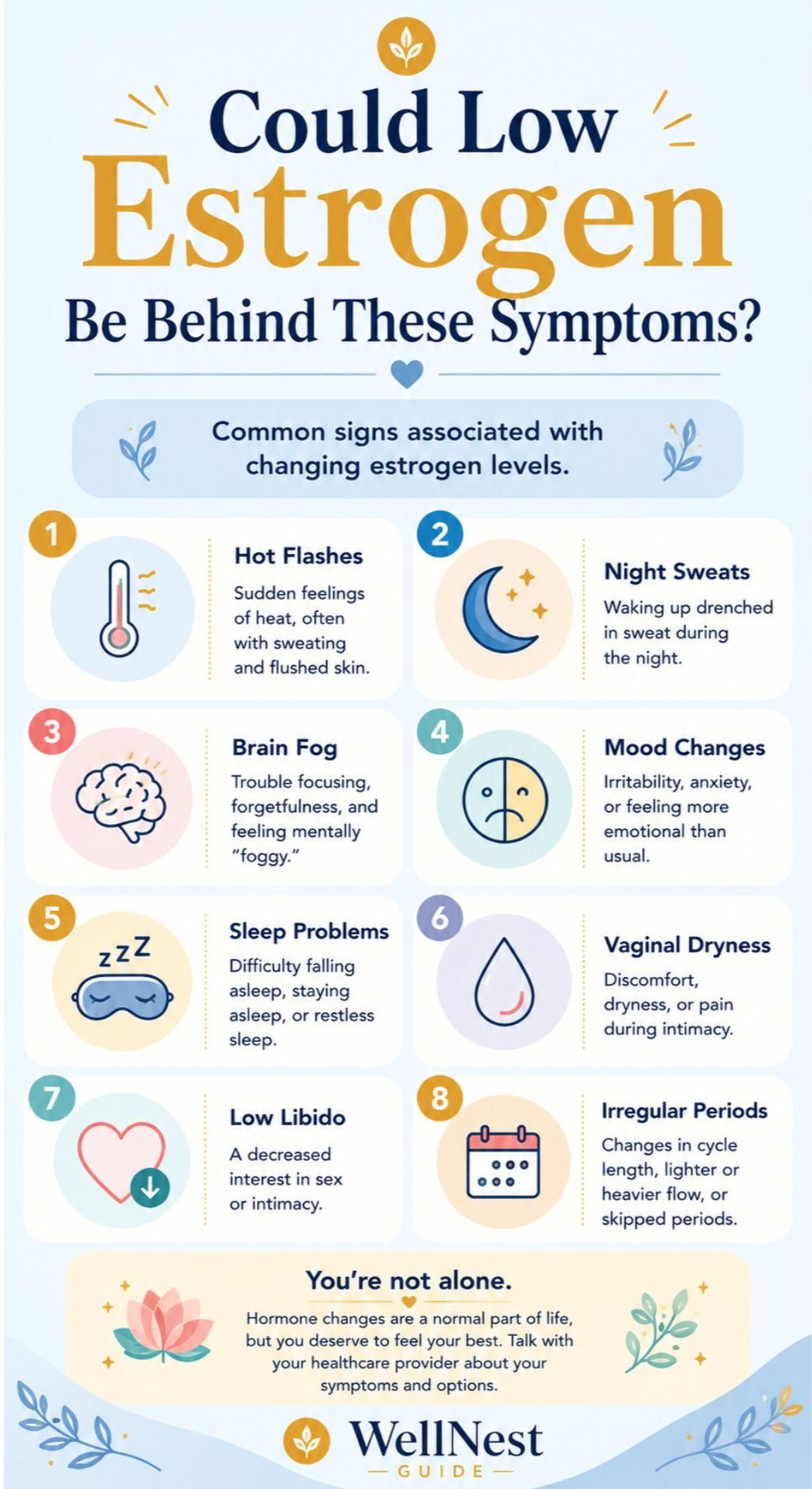
Some of the most common symptoms include fatigue, brain fog, anxiety, mood changes, sleep problems, hot flashes, night sweats, low libido, dry skin, hair thinning, and irregular periods.
Can low estrogen cause weight gain?
Low estrogen may contribute to changes in body composition and where fat is stored. Many women notice more weight accumulating around the midsection during perimenopause and menopause.
What age do low estrogen symptoms start?
Many women begin noticing symptoms during perimenopause, which often starts in their 40s. However, timing varies widely from person to person.
Can low estrogen affect sleep?
Yes. Difficulty sleeping, waking during the night, night sweats, and hot flashes are all commonly associated with changing estrogen levels.
What foods contain estrogen?
Foods commonly referred to as estrogen rich foods include flaxseed, soybeans, tofu, tempeh, edamame, chickpeas, lentils, and sesame seeds.
Final Thoughts
One of the most frustrating things about low estrogen symptoms is how easy they are to dismiss individually.
A little fatigue here. A little brain fog there. Some trouble sleeping. A shorter fuse than usual. Jeans that fit differently than they used to.
On their own, each symptom seems easy to explain away. But when several of them start showing up together, it’s natural to wonder whether something bigger is going on.
The good news is that understanding what’s happening is often the first step toward feeling more like yourself again. Whether you’re in perimenopause, approaching menopause, or simply trying to make sense of symptoms that seem to have appeared out of nowhere, paying attention to your body can provide valuable clues.
You don’t have to have all the answers today. But if this article helped connect a few dots, you’re already one step closer to understanding what your body may be trying to tell you.
Please note: This website contains affiliate links. As an Amazon Associate, we earn from qualifying purchases at no additional cost to you.